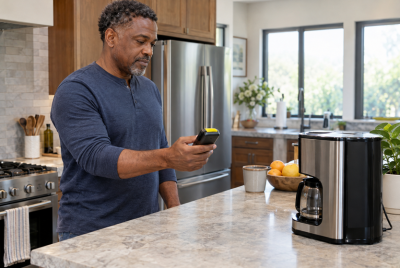
An EMF meter can help you measure certain electromagnetic fields in a particular place at a…
How To Choose An EMF Meter For Home Use
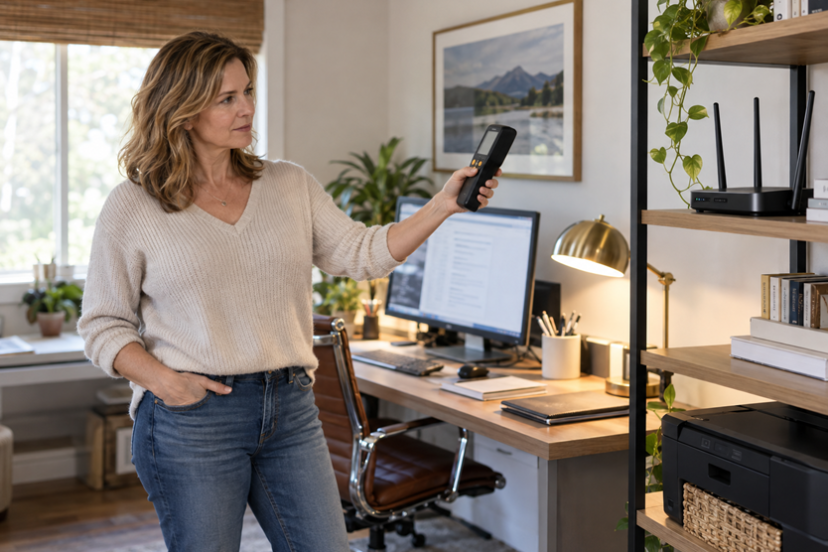
An EMF meter can be useful when you want to understand how electric fields, magnetic fields, or radiofrequency signals vary around your home. The right meter depends less on finding the product with the longest specification list and more on knowing what you actually want to measure and how much detail you want from the readings.
For many homeowners, a meter that measures AC magnetic fields, AC electric fields, and radiofrequency (RF) fields provides the most practical flexibility. Someone who simply wants to compare locations around a bedroom or home office may prefer a straightforward meter. Someone who wants to record measurements over time or investigate RF signals in more detail may want additional analytical features.
The important limitation is that an EMF meter measures electromagnetic fields. It does not diagnose a health problem or tell you by itself whether a particular reading is medically dangerous.
That distinction matters because ordinary household EMFs include different parts of the electromagnetic spectrum. Electrical wiring and appliances can produce extremely low-frequency electric and magnetic fields, while Wi-Fi equipment, cell phones, wireless devices, and similar technologies produce radiofrequency fields.
Current scientific evidence does not support treating every detectable EMF reading as evidence of harm. The World Health Organization notes that adverse health effects from low-level, long-term radiofrequency or power-frequency exposure have not been confirmed, while research continues in areas where uncertainties remain.
The most useful reason to buy a home EMF meter, therefore, is measurement and comparison—not diagnosis or proof of health risk.
What Are You Actually Trying To Measure?
Before comparing meters, identify the practical question you want the meter to answer.
You might want to determine:
- How measurements change as you move farther from a Wi-Fi router.
- Whether a particular appliance produces a noticeable magnetic field nearby.
- How electric-field measurements vary around a desk or sleeping area.
- Whether switching a device off changes the reading.
- How wireless measurements compare in different rooms.
- Whether repositioning equipment produces a measurable difference.
Those are questions a meter can help investigate.
A meter cannot tell you that a particular reading caused a symptom, predict whether someone will develop an illness, or establish that a room is universally “safe” or “unsafe.”
That requires a different kind of evidence than a consumer measurement device can provide.
The Three Types Of Measurements That Matter Most
Many home EMF meters combine three different measurements in one device.
AC Magnetic Fields
Magnetic fields are commonly associated with electrical current flowing through wiring, motors, transformers, appliances, power supplies, and other electrical equipment.
They are commonly displayed in:
- milligauss (mG)
- microtesla (µT)
A three-axis magnetic sensor can make household measurements easier because it measures multiple spatial directions without requiring the user to orient the meter as precisely.
AC Electric Fields
Electric fields can exist around energized wiring and electrical devices even when relatively little current is flowing.
They are commonly displayed in:
- volts per meter (V/m)
Electric-field measurements can be affected by meter position, grounding conditions, the person holding the meter, surrounding objects, and other aspects of the measurement setup. Consistency matters when comparing one reading with another.
Radiofrequency Fields
Radiofrequency measurements are relevant to wireless technologies such as:
- Wi-Fi
- cellular devices
- Bluetooth equipment
- cordless devices
- some smart-home equipment
RF meters commonly report power density using units such as:
- microwatts per square meter
- milliwatts per square meter
- microwatts per square centimeter
Different meters cover different frequency ranges, so checking frequency coverage is important if you have a particular source you intend to investigate.
Do You Actually Need An EMF Meter?
Not everyone interested in reducing unnecessary exposure needs to purchase a meter.
A meter makes more sense when you want to measure, compare, troubleshoot, or document what is happening in your particular environment.
For example, a meter can help you determine whether moving a device three feet away actually changes a reading, rather than assuming that it does.
A meter may be unnecessary if you already know the specific change you want to make.
If you simply want your phone farther away while you sleep, you can move it.
If you want a router farther from a frequently occupied chair, you can reposition it when practical.
If you want to use an Ethernet connection instead of Wi-Fi for a stationary computer, you do not necessarily need a meter before doing so.
Distance itself can substantially affect exposure from many sources. WHO notes that electric and magnetic fields around household appliances generally decrease rapidly with distance, and NCI similarly notes that radiofrequency exposure from a phone declines rapidly as distance increases.
Those changes can be made as personal precautionary or setup choices without assuming that the original arrangement was medically dangerous.
5 Things To Consider When Choosing A Home EMF Meter
1. Which Fields Does It Measure?
This is the first specification to check.
Some inexpensive meters measure only AC electric and magnetic fields. Others also measure RF.
If your goal includes investigating Wi-Fi, cellular, Bluetooth, or similar wireless sources, you will generally need RF measurement capability.
For broader household investigation, a three-field meter that measures:
- AC magnetic fields
- AC electric fields
- RF fields
is usually more versatile.
Do not assume that every product labeled an “EMF meter” measures all three.
2. Measurement Range And Frequency Coverage
A meter’s frequency range tells you which signals its sensors are designed to detect.
Broader frequency coverage can be useful, but a larger number on the specification sheet does not automatically make a meter more appropriate for every homeowner.
Think about the sources you actually expect to investigate.
For example, the TriField TF2 specifies RF coverage from 20 MHz to 6 GHz, while GQ specifies RF detection up to 10 GHz for the EMF-390. The ERICKHILL RT-100S specifies an RF measurement bandwidth of 50 MHz to 3.5 GHz.
The more important question is whether the meter covers the types of sources you plan to measure—not whether its maximum frequency specification is larger than another product’s.
3. Sensor Orientation And Ease Of Measurement
Sensor design can affect how easy it is to obtain repeatable readings.
A three-axis magnetic sensor measures magnetic-field components in multiple directions. That can make scanning around appliances or rooms more convenient because meter orientation becomes less critical.
The TriField TF2 specifies three-axis AC magnetic measurement, as does the GQ EMF-390.
Ease of use matters particularly if your main goal is to make simple before-and-after comparisons around your home.
A technically sophisticated meter is not automatically more useful if its additional functions make it harder for you to perform consistent measurements.
4. Simple Readings Versus Data Logging And Analysis
Consider how much information you really want.
Some homeowners need little more than:
- Turn on the meter.
- Select or view a field.
- Take a reading.
- Move farther away.
- Compare the result.
Others may want to record measurements over time or investigate RF activity in greater detail.
The GQ EMF-390 includes internal data logging and can transfer recorded data to companion PC software for analysis and CSV export. It also includes an RF spectrum-analysis function covering specific frequency bands. Importantly, its spectrum analyzer should not be confused with a laboratory-grade general-purpose spectrum analyzer; GQ’s documentation identifies particular bands that the function covers.
If you will never use logging, computer analysis, or spectrum information, paying for those capabilities may provide little practical benefit.
5. How Easily You Can Interpret The Results
A good home meter should help you answer a practical question without encouraging you to overinterpret the display.
Meters may include:
- audible alarms
- color-coded displays
- peak indicators
- maximum values
- configurable warnings
- multiple measurement units
Those features can make changes easier to notice.
However, an alarm or display color should not automatically be interpreted as a medical danger threshold. It may simply reflect a threshold programmed into that particular instrument.
The useful question is often comparative:
What happens to the measured field when something changes?
For example:
- Router on versus router off.
- One foot away versus six feet away.
- Appliance running versus not running.
- Device beside the bed versus across the room.
- Wireless connection versus a wired setup.
That approach gives the meter a specific measurement job rather than asking it to answer a health question it was not designed to resolve.
Three EMF Meters For Different Home-Use Needs
The following meters represent three different approaches to home EMF measurement.
They are examples rather than universal rankings, and no firsthand testing by EMF Insiders is being claimed.
TriField TF2 EMF Meter — Model TF2
May Be A Good Fit For:
Someone who wants a relatively straightforward meter for checking magnetic, electric, and RF fields around a home without extensive menus or computer-based analysis.
Why It May Fit
The TriField TF2 combines three measurement functions:
- AC magnetic fields
- AC electric fields
- RF/microwave power density
Its AC magnetic mode covers 40 Hz to 100 kHz, with a maximum range of 100 mG and 0.1 mG resolution. Its electric-field mode covers 40 Hz to 100 kHz with measurements up to 1,000 V/m. RF coverage is specified from 20 MHz to 6 GHz.
The magnetic sensor is three-axis, which helps reduce the importance of meter orientation during magnetic-field measurements. The meter also includes peak-hold capability and an audio indicator that can help when locating changes in field strength.
Things To Consider
The TF2 is oriented more toward direct spot measurements than detailed data analysis.
Its magnetic measurement is three-axis, while its electric and RF measurements are specified as single-axis. If your priority is recording measurements over extended periods or examining RF frequency activity in greater detail, another type of meter may fit that job better.
TriField also includes a manufacturer-specific frequency-weighted measurement mode. That feature should be understood as an instrument measurement mode rather than as proof that a displayed value establishes a particular health outcome.
Check the TriField TF2 on Amazon
GQ Electronics EMF-390 Multi-Field EMF/ELF/RF Meter
May Be A Good Fit For:
Someone who wants more measurement and analysis capabilities, including data logging and additional RF investigation tools.
Why It May Fit
The GQ EMF-390 measures magnetic, electric, and RF fields.
Its published specifications include:
- Three-axis magnetic-field measurement up to 500 mG or 50 µT
- Electric-field measurement from 0 to 1,000 V/m
- RF field measurement with detection capability extending up to 10 GHz on the EMF-390
The EMF-390 also includes internal memory for data logging. GQ’s companion PC software can display measurements, retrieve recorded history, and export data in CSV format.
Another distinguishing feature is its RF spectrum-analysis capability. GQ documents several specific spectrum-analysis bands rather than continuous spectrum analysis across the meter’s entire RF detection range.
Things To Consider
The EMF-390 offers substantially more functions to learn than a simple point-and-read meter.
That can be useful if you intend to study changes over time, save readings, or investigate RF activity more closely. It can also be unnecessary complexity if your only goal is occasionally checking a router, appliance, or workstation.
Be careful to distinguish the meter’s broad RF detection specification from the specific bands covered by its spectrum-analysis function.
Check the GQ Electronics EMF-390 on Amazon
ERICKHILL RT-100S 3-in-1 EMF Detector
May Be A Good Fit For:
Someone primarily interested in straightforward household measurements with all three field readings available in a compact rechargeable meter.
Why It May Fit
The RT-100S measures electric, magnetic, and RF fields.
ERICKHILL specifies:
- Electric field: 1 to 1,999 V/m
- Magnetic field: 0.01 to 99.99 µT, or 0.1 to 999.99 mG
- RF power density: 0.01 to 300 mW/m²
- RF measurement bandwidth: 50 MHz to 3.5 GHz
- Sampling time of approximately 0.4 seconds
The meter is designed to display the three measurement types simultaneously and uses a rechargeable 3.7-volt lithium battery.
Things To Consider
Its RF frequency coverage is narrower than that specified for the TriField TF2 and GQ EMF-390.
ERICKHILL also incorporates color and alarm thresholds into the meter. Those indicators can help draw attention to changes in readings, but the manufacturer’s preset alarm levels should not be treated as medical diagnoses or universal health boundaries.
For someone mainly making relative household comparisons, the simpler interface may be more relevant than advanced analysis functions.
Check the ERICKHILL RT-100S on Amazon
A Simple Way To Use An EMF Meter At Home
Buying a meter is only part of the process. Measurement technique matters.
Rather than walking through your home searching for the largest number, start with a specific question.
Suppose you want to investigate your home-office router.
Step 1: Establish A Consistent Measurement Position
Choose a repeatable location and hold or place the meter consistently.
Step 2: Record A Baseline Reading
Take a measurement under normal operating conditions.
Step 3: Change One Variable
For example:
- increase the distance
- relocate the router
- turn the router off temporarily
- move another wireless device
- disconnect an electrical appliance
Step 4: Measure Again
Use approximately the same meter position and orientation where applicable.
Step 5: Compare The Results
You now know whether the change produced a measurable difference.
That is generally more useful than treating a single isolated number as a verdict.
Common EMF Meter Buying Mistakes
Buying A Meter Without Knowing Which Fields It Measures
An inexpensive EMF detector may measure electric and magnetic fields but not RF.
If Wi-Fi and wireless devices are part of your reason for purchasing a meter, verify RF capability before ordering.
Assuming More Frequency Coverage Automatically Means Better
Broad coverage can be valuable when you need it.
But a meter covering frequencies you will never investigate may not improve your actual home measurements.
Choose specifications according to purpose rather than the largest numbers on the package.
Treating Color-Coded Warnings As Health Diagnoses
A display changing from green to yellow or red can make a meter easy to use.
It does not establish that the reading represents a medical danger.
Understand what the manufacturer programmed those thresholds to represent before assigning additional meaning to them.
Comparing Measurements Taken Under Different Conditions
EMF readings can change with:
- distance
- orientation
- device activity
- nearby electronics
- location
- wireless traffic
If you want meaningful comparisons, change one major variable at a time whenever practical.
Assuming A More Expensive Meter Provides More Health Protection
A meter does not protect you simply because you own it.
Its value comes from the information it provides and what practical decisions you make with that information.
Advanced capabilities such as logging or spectrum analysis may justify additional cost for some users, but they do not make the device a medical instrument.
Chasing Every Detectable Signal
Modern homes contain many sources of electromagnetic fields.
Detecting a field does not automatically mean you have discovered a problem.
WHO distinguishes between the existence of a measurable biological effect and evidence of an adverse health effect, and current evidence does not support interpreting ordinary low-level household measurements as automatic evidence of harm.
A meter is most useful when it answers a defined question.
Consider Simple Changes Before Buying More Products
If your goal is simply to reduce an unnecessary source or lower a measurement, the first solution does not always need to be another product.
Depending on the situation, you might be able to:
- increase distance from a device
- relocate a router
- move charging equipment away from frequently occupied areas
- turn off equipment when it is genuinely not needed
- use a wired connection where it makes practical sense
- change where wireless equipment is positioned
- reduce unnecessary device use
These steps should be understood as practical ways of changing a setup or reducing measured exposure—not as evidence that the original exposure was causing harm.
This distinction also helps prevent an EMF meter from becoming the beginning of an endless cycle of purchasing products for every reading you find.
Final Decision Checklist
Before choosing an EMF meter, ask:
- What am I actually trying to measure?
- Do I need magnetic, electric, RF measurement—or all three?
- Does the meter’s frequency range cover the sources I want to investigate?
- Do I want simple spot measurements or logging and deeper analysis?
- Will I realistically use advanced features such as spectrum analysis?
- Can I understand and consistently reproduce the measurements?
- Am I treating manufacturer alarm thresholds as more meaningful than they actually are?
- Am I expecting the meter to answer a health question that measurements alone cannot resolve?
- Could a simple distance, placement, wired-connection, or usage change accomplish my practical goal without another purchase?
The Bottom Line
For most home users, choosing an EMF meter comes down to measurement scope, usability, and the amount of analysis you actually need.
The TriField TF2 emphasizes relatively straightforward three-field measurement. The GQ EMF-390 adds features such as data logging and RF spectrum-analysis tools for users who want to investigate measurements more deeply. The ERICKHILL RT-100S provides electric, magnetic, and RF readings in a simpler rechargeable format.
None of those distinctions establishes that one meter provides greater health protection.
A useful EMF meter helps you measure your environment, compare practical changes, and understand where fields are coming from. What it cannot do is turn a single number into a medical conclusion.
Approached that way, an EMF meter can be a practical information tool rather than a source of unnecessary worry.

More to Explore