If you want to make your home feel a little more intentional around EMF exposure, the…
Simple Device Placement Changes That May Help Reduce EMF Exposure
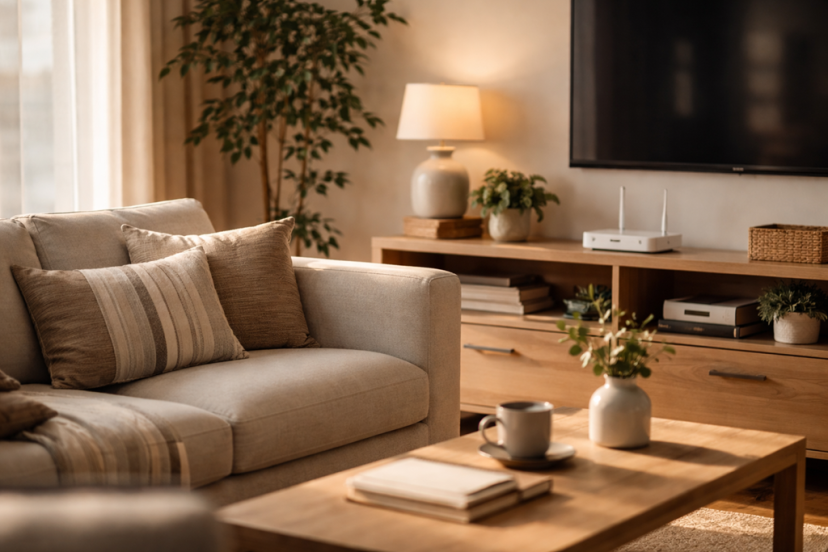
Small changes in where you place everyday devices can sometimes reduce unnecessary close-range exposure without requiring a complete lifestyle overhaul. For many people, this is less about eliminating technology and more about creating a little more distance between the body and the devices they use most often.
That matters because device placement is one of the easiest parts of daily life to adjust. You may not be able to avoid every phone, router, laptop, or wireless signal around you, but you can often rethink where those devices sit, how long they stay close to your body, and whether a simple repositioning makes your setup feel more intentional.
For people trying to make calmer, more practical decisions about EMF, device placement is often a good place to start.
Why this question comes up so often
Most people do not spend time thinking about EMF exposure until a habit suddenly feels worth questioning.
It might be sleeping with a phone under the pillow or on the nightstand inches from the head. It might be resting a laptop directly on the lap for long stretches. It might be keeping a Wi-Fi router in the busiest part of the home simply because that is where the cable connection happened to be installed. Sometimes it is not fear that starts the question. It is just the realization that devices have become physically closer to the body than they used to be.
That can leave people wondering whether they need to change everything at once, or whether simple adjustments are enough to make a meaningful difference in day-to-day habits.
The most useful principle is often distance
One of the clearest practical ideas in this area is that distance often matters. In everyday terms, a device usually does not have to be touching your body to work well. Because of that, some of the easiest changes involve moving devices a little farther away when there is no real reason to keep them pressed against you.
This does not mean every nearby device is automatically dangerous, and it does not mean normal technology use needs to become stressful. It simply means that if a phone can sit on a table instead of in a pocket, or if a router can be placed across the room instead of beside the bed, those are reasonable adjustments many people can make without much disruption.
That is part of what makes device placement a practical topic rather than an all-or-nothing one.
A few placement changes people commonly consider
Some device placement habits tend to come up again and again because they are easy to overlook.
Phones do not always need to live against the body
Many people carry phones in a pocket, tuck them into clothing, or set them beside the pillow at night out of convenience. But when the phone is not actively being used, it can often be placed in a bag, on a desk, on a nearby shelf, or on a dresser instead.
That does not require abandoning the phone. It just reduces the habit of constant body contact.
Laptops work better on a desk than on the lap
The name “laptop” makes direct lap use sound natural, but in practical terms, a desk or table is often the better home base. It can improve posture, airflow, and comfort while also creating some distance from the body.
This is one of the simplest examples of a placement change that feels ordinary once it becomes routine.
Routers are often better placed with function and space in mind
A Wi-Fi router is usually placed wherever installation was easiest, not necessarily where it makes the most sense long term. In many homes, that means it ends up near a couch, bed, or heavily used workstation.
When possible, some people prefer to place it in a less occupied area while still keeping the connection usable. The goal is not to hide it in a useless location. The goal is to avoid placing it right beside the spot where someone spends hours every day.
Bedsides can become default device storage zones
Bedrooms often collect devices by habit. Phones, tablets, chargers, smart watches, and other electronics can end up concentrated near the bed simply because that feels convenient.
For people trying to be more thoughtful about nighttime routines, one of the easiest changes is to create a little separation. A dresser across the room, a shelf, or a designated charging area outside the immediate sleep space may feel more deliberate and less cluttered.
Why these changes matter in everyday decision-making
The practical value of device placement changes is not that they solve every EMF question. It is that they help people make calmer decisions in situations they actually control.
That can reduce the feeling of helplessness that sometimes builds around this topic. Many EMF questions become overwhelming when people assume the only meaningful response is a complete home overhaul or expensive equipment. In reality, small choices about placement can offer a more manageable starting point.
That matters because sustainable habits are usually more useful than reactive ones. A minor change you can keep doing every day is often more helpful than a dramatic change that creates stress and quickly falls apart.
What makes this issue confusing
This topic becomes confusing fast because people tend to run into two extremes.
One extreme treats all EMF concerns as irrational and not worth thinking about at all. The other treats every device as an urgent threat that must be aggressively controlled. Neither extreme is especially helpful for someone trying to make thoughtful, practical choices at home.
Another source of confusion is the idea that every adjustment must produce certainty. In reality, many people are not looking for certainty. They are simply trying to reduce unnecessary close contact where doing so is easy and reasonable.
That is a different mindset. It is less about panic and more about preference, margin, and everyday design.
A helpful reframe: not every exposure needs the same response
People often feel overwhelmed because they lump all devices and all situations together. But a phone pressed against the body for long periods is not the same scenario as a device sitting across the room. A router next to a bed is not the same as a router placed in a less occupied area. A laptop on the lap for hours is not the same as a laptop on a desk.
This does not mean you need to rank every device with perfect precision. It simply means context matters.
That reframe can make the topic feel much less emotionally loaded. Instead of asking, “How do I eliminate everything?” a calmer question is, “Where am I keeping devices unnecessarily close, and which small changes are easiest to make?”
That question is usually much more answerable.
Common misunderstandings that lead to overreaction
One common misunderstanding is thinking that if a change is simple, it must also be pointless. But ease does not make a habit irrelevant. In many areas of daily life, simple environmental changes matter precisely because they are repeatable.
Another misunderstanding is assuming that a practical adjustment means you are admitting something catastrophic is happening. That is not true either. People make precautionary choices for many reasons, including comfort, uncertainty, preference, and common-sense design.
A third pattern is treating product purchases as the main path forward. For many readers, the first useful step is not buying anything. It is noticing where devices are currently placed and asking whether those placements are necessary.
That alone can create a more grounded sense of control.
What a balanced approach looks like
A balanced approach usually means keeping technology in perspective while still making reasonable placement decisions where they are easy to apply.
It may look like charging your phone somewhere other than under your pillow. It may look like using speakerphone or a table during longer calls when practical. It may look like moving a router away from the place where someone sits for most of the day. It may look like turning a “default habit” into a “deliberate habit.”
These are not dramatic measures. They are everyday adjustments that can make device use feel more intentional.
And that is often the most useful place to land with this topic: not in panic, not in dismissal, but in a calmer, more practical middle ground.
The takeaway
Simple device placement changes may help reduce unnecessary close-range EMF exposure in ways that are easy to live with. They are not a full system, and they do not answer every bigger question about EMF. But they can help you create a little more distance, a little more intention, and a little less mental noise around everyday technology use.
For many people, that is enough to make the issue feel clearer. You do not need to solve everything at once. Sometimes the most useful next step is just noticing which devices are unnecessarily close, and choosing a better place for them.

More to Explore